Before I formed you in the womb, I knew you; and before you were, I set you apart (Jeremiah 1:5)

Tuesday, November 12, 2019

Feet on the Ground and Head Held High

 “Feet on the Ground and Head Held High” was preached at Sunnyside Presbyterian Church on November 10, 2019. This was my final sermon at Sunnyside, as I have received a new call at a different community of faith. This sermon was inspired by Scripture, commentaries, reflections of gratitude, times of transition, and my call as associate pastor at Sunnyside. You can listen to an audio clip of this sermon here. You can watch a video of the entire worship service here.

--

2 Thessalonians 2:1-5, 13-17

1 As to the coming of our Lord Jesus Christ and our being gathered together to him, we beg you, brothers and sisters, 2 not to be quickly shaken in mind or alarmed, either by spirit or by word or by letter, as though from us, to the effect that the day of the Lord is already here. 3 Let no one deceive you in any way; for that day will not come unless the rebellion comes first and the lawless one is revealed, the one destined for destruction. 4 He opposes and exalts himself above every so-called god or object of worship, so that he takes his seat in the temple of God, declaring himself to be God. 5 Do you not remember that I told you these things when I was still with you?

13 But we must always give thanks to God for you, brothers and sisters beloved by the Lord, because God chose you as the first fruits for salvation through sanctification by the Spirit and through belief in the truth. 14 For this purpose he called you through our proclamation of the good news, so that you may obtain the glory of our Lord Jesus Christ. 15 So then, brothers and sisters, stand firm and hold fast to the traditions that you were taught by us, either by word of mouth or by our letter.

16 Now may our Lord Jesus Christ himself and God our Father, who loved us and through grace gave us eternal comfort and good hope, 17 comfort your hearts and strengthen them in every good work and word.

--

The last three years serving as one of your pastors have been both the best and worst years of ministry for me.

Now before any of you are offended or perhaps flattered, just remember these have been my only years of ministry. So I really do mean that; it’s been the best and the worst. And honestly, it’s been mostly great, so yes, you can all be a little flattered. I’m flattered.

I started serving at Sunnyside Presbyterian Church on September 1, 2016.

And after that first week, I thought everything was peaceful and calm and it was wonderful and great and ministry looked to be easy and exciting and I thought to myself that this would be like riding a bike… and that I could ride this bike.

And then, maybe it was a week or two after that, Jamie, the former senior pastor here, fell down a flight of stairs, did some major damage to his knee, and was out of the office for the next month or so. Do you all remember that?

So here I was, a novice pastor, not even ordained yet, thrown into the deep end of ministry. Sink or swim; let’s do this.

Because Jamie was out due to his injury, Susan and I had to cover his planned sermons, as well as a few other responsibilities. The first sermon I was assigned to was on Jamie’s preplanned topic of faithfulness and money. I even made a joke in that sermon saying “hazing in the church is equivalent to making the new pastor preach on money.” Maybe it’s almost fitting that my last sermon at Sunnyside is also on the day we end our stewardship campaign. But today we’re not going to talk about money… but also real quick, seriously, stewardship is important, so please get those pledges in. That’s all I’m going to say on that. Stewardship committee, I’ll leave the rest to you in your minute for mission.

Anyway, following former head pastor Jamie’s serious fall and during my first couple of weeks at Sunnyside, I learned right away that ministry was maybe not as peaceful or calm as I first thought and that maybe it wouldn’t be as wonderful and great all the time and that actually it wouldn’t be so easy… but hey, at least it was still exciting! I learned that ministry wouldn’t be like riding a bike. I learned that ministry is like learning to ride a bike. Because right away I experienced moments where there were bumps and bruises and where it felt like I fell. But eventually it would get easier, right? Everything should become more stable and balanced and steady, right?

Of course not, because then I learned that ministry is like learning how to ride a bike where each time you step on the pedal, something else changes. Like one day in ministry, it’s learning how to ride the bike with the tires flat. And then the next week in ministry, it’s learning how to ride the bike blindfolded. And then in the next month, it’s learning to ride with no handlebars and then soon its learning how to ride on loose gravel and then it’s something else and then something else and then something else. So then of course there were more bumps and more bruises and more falls.

But I also learned that in ministry, it wasn’t me alone learning how to ride this ever-changing bike. You were too. As a community, we were learning how to ride this bike together. Because that first month with Jamie down and out, you all had to learn how to let me be one of your pastors. So when I started up on this path learning how to do ministry, so did you. We started learning how to ride this ministerial metaphorical bike together, and we’ve been learning every day since, each day with its own unexpected challenges and changes. Because you too experienced and felt the bumps and the bruises and the falls.

As I said, ministry is like learning how to ride a bike that some days resembles a bike and other days something else altogether, and yet we learning it as a community, as one body.

This has been true this past year. This has been true since September 2016. It’s been true since 2014. It was true since 1997. It’s been true since Sunnyside started in 1870 and it’s been true long before that.

Ministry was like learning to ride a bike long before bikes were invited. The church learning how to do ministry is a thing dating back to when the church first started.

Take for example, the church in Thessalonica. In Paul’s second letter to the Thessalonians, which may have been written by Paul or an author imitating Paul but for the sake of this sermon, we’ll say Paul – In Paul’s second letter to the Thessalonians, we see a community that is afflicted by staleness and unrest.

This early church community became stale because they were still. They have been waiting for the coming of the Lord, something that promised to them as their church was founded; as the Church was founded. And they were waiting, as it was told to them, because they thought the coming of the Lord would happen in their lifetime. So they just kind of sat there, did nothing, proclaimed no good news, did no good works, did nothing. They just… waited. If ministry is like learning how to ride a bike, then the Thessalonians refused to even pick up their bike. It’s kind of just sitting off to the side. They thought to themselves: Why learn how to ride a bike or why learn how to do ministry, when the Lord is coming. So they don’t even try. They just… wait.  

But then all of a sudden, they are told that before the Lord comes, someone who imitates the Lord but is not the Lord would come instead. And the Thessalonians are so out of practice of knowing what to do in times of unrest, that they become shaken and alarmed. After all, they put their bike, their will to do ministry, off to the side. They thought they had no need to stay active and alert in their faith. And because they are so out of touch with their faith, rumors start flying. Emotions and fears are magnified. Things are heated and tense. Speculations rise, and therefore so does deception. And it becomes so intense, that all of our sudden, this community of faith is falling apart because they are simply scared and worried as they are not connected enough with their faith and trust in God.

So Paul, seeing this community tear itself apart, writes them this letter. In their fear and in their speculations, Paul tells them to cease and desist. To stop. Right now. It’s not a question or a request. It is a full command to them using his authority as an apostle of Christ. Here in this moment, Paul commands the Thessalonians to stop worrying, to stop speculating, to stop spreading rumors, to stop the deception, to stop unintentionally destroying themselves because they can’t help but let their fear or their anger or their sadness get the best of themselves.  Paul commands them to go pick up their bike and learn to do ministry as a community once more.

And so Paul then tells them how they can do this.

Paul writes that if they as a community are reminded of the positive and foundational power of the message of the Gospel, then there will be no place for rumors or fear to occupy any capacity of the spirit or mind. To be reminded of this, all they need to do is look inward and see where the holy works of God have lived and continues to live within themselves and their community.

He reminds them their very salvation that was gifted to them is not just a matter of hope in a future coming but rather something already displayed in any moment of faith or trust or holiness. To experience any of these things as a community is a sure sign that the Spirit of God is present among them and working for their good.

How will the Thessalonians be given the will to get back on the path to ministry? Paul tells them they will need to turn to God and be reminded of what God has been done and what good can be done. They must remember what they have experienced as a community and what they will continue to experience as a community. It is then, that as a body of Christ, that in any future moments of bumps or bruises or falls, they will be able to comfort one another in hope and faithfulness because they have before and they will again. And above all else, God has promised to do the same; that God too will be a source of eternal comfort and good hope. With this promise, the Thessalonians can stand firm and hold fast… and get back to learning how to ride that infamous bike metaphor we’ve been talking about this entire time.

Friends, is that also not true for us, right here and right now? It has been true in our past, and I believe it will be true in our future.

In times of transitions, here in the church and in our own lives, it seems like we are given two great grand options. In times of transition, we can either be still and stale and be filled with fear and unrest… or we can place our hope and trust in God because we know with faith what good God has done in our lives.

So yeah, today is a day of transition. For all of us. For many reasons. Yes, in a few shorts moments, I will no longer be one of your pastors. That’s going to be a moment of transition. But that’s not the only moment here. That’s not the only moment of transition that we are experiencing as a church and definitely not the only moment of transition in our own personal lives. We all have something. I know we do. I know you know what transitions you’re currently experiencing, and what fear or unrest that may be causing you.

Let us return to this bike metaphor one more time. Think of the moment you or someone you love learned how to ride a bike. You or they might have been a young child. Think of that child. This child, whether it is you or someone you love, is determined. Maybe they have already experienced riding a bike with training wheels and that was fun and all… but this is going to be so much better. With excitement but perhaps a little nervousness, they grab the bike. They push off, they pedal, maybe there’s some assistance from someone they trust, and then they go. They go as far as they can. And maybe, just maybe, they experience that bump or that bruise and they fall to the ground. As we fall to the ground. And for a moment, it all seems impossible as we lay there, the bike now fallen beside us. But yet we try again. Now with tears or scraped knees, we try again. We stand up and we remember why we want to do this, because this will be better than what we have already experienced. We plant our feet on the ground, we hold our heads high, and we grab our bikes and try again. And we push off once more.

We’ve had our time to worry. But today is no longer going to continue to be that day. Today we will remember what good God has done in our lives. Today we will be comforted and strengthened by this good.

But speaking of this transition in our relationship with one another. Three years ago, we were given the gift and the responsibility to be in covenant with one another. I was new to ministry; young in age; unknown to Sunnyside, South Bend, and Indiana; and yet God brought us together. And for me, that moment was good. And it has been good. Even when it wasn’t so great, it was good… because God did this for us, and what God does is good.

And now God is doing something else… and we’re all being given new gifts and responsibilities. But still our relationship was good; our memories are good. So I am comforted; I am strengthened, and I am ready. And may you be comforted, may you be strengthened, you are ready.

Through salvation and grace, hope and strength; glory and faithfulness; good works and holy words; through all of this, we will plant our feet on the ground and hold our heads high. We have work to do. We have ministry to do. Thanks be to God. Amen. 

--


Tuesday, November 5, 2019

Recovering Image-Bearers

“Recovering Image-Bearers” was preached at First Presbyterian Church of Allentown, PA on September 15, 2019. This sermon was inspired by Scripture, commentaries, introductions & testimonies, story-telling, youth ministry, celebrating identity, and a lecture by Craig Detweiler. You can watch this sermon at FPCA’s alternative sermon here, starting at 17:00. 

--

Luke 15:3-7

3 So Jesus told them this parable: 4 “Which one of you, having a hundred sheep and losing one of them, does not leave the ninety-nine in the wilderness and go after the one that is lost until he finds it? 5 When he has found it, he lays it on his shoulders and rejoices. 6 And when he comes home, he calls together his friends and neighbors, saying to them, ‘Rejoice with me, for I have found my sheep that was lost.’ 7 Just so, I tell you, there will be more joy in heaven over one sinner who repents than over ninety-nine righteous persons who need no repentance.

--

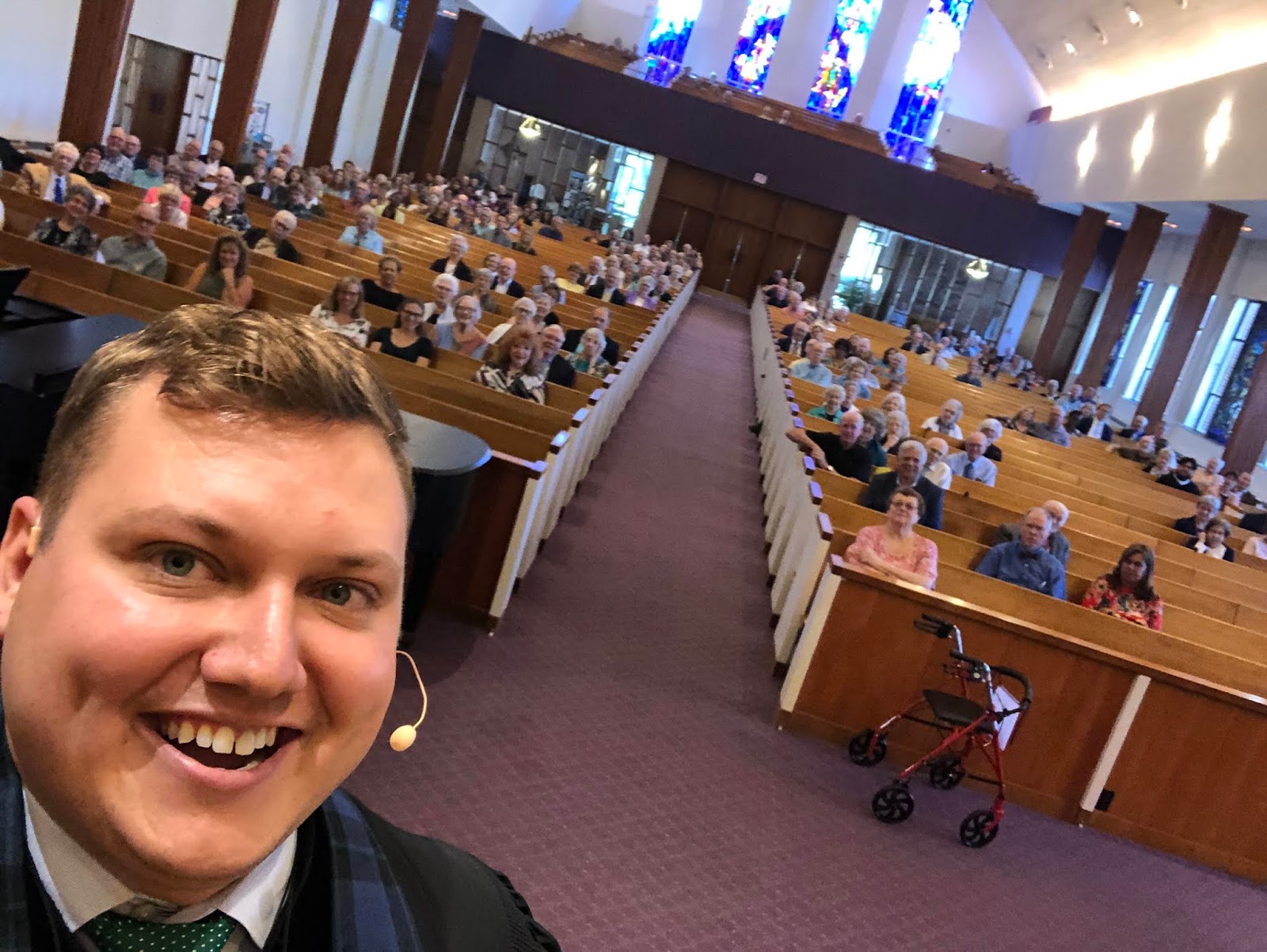
Wait. Just a moment. I need to do something first.

Let me take a selfie. This photo is for us, to capture this moment, to remind of us this memory.


We’ll look back on this picture and we’ll remember how great this day was. Or hopefully how great this day was depending on the vote later. Either way, we’ll have this selfie to document it.

But this is more than just a selfie, right? It’s more than just a picture of all of us. It’s a symbol of a united flock. Metaphorically speaking using our passage from the Gospel of Luke, it is the symbol of God’s flock of sheep. You, me – all of us, gathered together as one before our Shepherd the Christ. This picture; this selfie – shows this! It shows our togetherness, strengthened and supported by one another, smiling and laughing, possibly wondering where this sermon illustration is headed… hey, you’re considering me as an Associate Pastor for Youth and Faith Formation; this shows like the youth, I too know how to take a selfie. But I promise this picture – this selfie – is also taken for another reason

As I said, this picture shows the flock that we are. But does it show who is currently missing? Does it show those who were once was separated from the flock? Does it show those who were once lost from their shepherd? Does it even show those who have since been found and returned?

I can look at this photo, and I see great things; great people! – united together here on this day; but what I don’t see is your individual histories or pasts or stories. I can’t look at a face here and say, this person felt separated from the flock during this period of their life because of this reason. That’s what this photo doesn’t reveal.

Instead, our stories are revealed by the moments we do share together and in the conversations that we have. I pray that one day I do get to hear your stories; that we will get to sit down with one another and have those conversations and that you would share your story with me; the good and the bad; whatever has led you to this place and time. This is how we get to know one another; this is how God’s flock stays together.

So being the preacher that I am believing that sermons are intimate conversations we have with one another and with God… and because as of this point, I am a stranger to nearly all of you; I’m hoping I can use a part of this time to tell you a small part of my story. I want to get to know you and I hope you want to get to know me.

I grew up in the church. This was important for my family. As a family, we would probably be in church once or twice a month, as our schedules allowed. We were a sports family; my brothers and I all competed in different sports so on the Sundays we weren’t traveling for that, we would be in church, Sunday School, etc. So we weren’t the perfect attenders but enough for the pastors and other church goers to know us and for us to know them. And most importantly, we went enough for us to know God. Now my family moved from North Dakota to Colorado when I was entering into seventh grade, and when we moved, we joined the local Presbyterian church in my small rural town, as they at the time had the most active youth program. Sound familiar to any families out there?

Between the summer of my eighth grade year and freshmen year, I along with the youth group at my church went on a two-hour trip to a waterpark. During that trip, while we were all on the bus, two of our youth leaders were having a conversation about a same-sex couple they knew. This couple they were talking about had been trying to have a baby for several years, but unfortunately, each time one of them became pregnant, the pregnancy would end in a miscarriage. I’ll never forget what one of my youth leaders said as to why this was the case. The words are seared into my memory. She said, “Obviously this is God punishing them for the lifestyle they live.”

I always apologize when I tell this story, but it’s an important story for me to tell as it started my journey to becoming pastor. I apologize when I when I tell this story for how offensive this might be for those of you who are part of the LGBTQ community or for those of you who have experienced any kind of loss during pregnancy. As a youth, I wasn’t certain if I believed these words for myself, but my youth leader’s words were the ones I believed the church believed. You see, I came out as gay to my family and friends toward the end of high school. And as someone who was incredibly insecure of my sexual orientation when I first came out, I couldn’t be around people or communities, especially communities of faith, that believed God would punish people for who they loved; you know, punish people like me for being gay. 

For many years, I was deeply hurt by the church. I spent my years as a youth angry at the church and angry at God. I spent the first couple of my college years totally disconnected from the church, still so incredibly angry and wounded.

If we think in terms of this parable that we read today, you could say that for a while, I was a lost sheep who had left the flock. Maybe you can relate to this. Maybe you have a story – a moment in time, whether for a few days or maybe a couple of years – where for whatever reason, you felt lost from the flock. Maybe it was a time of illness or maybe the time of a divorce. Maybe you felt lost because the loss of a job or maybe the death of someone you love. Maybe you felt separated because you heard a person in power or of faith proclaim a message so harmful that it left a wound. Or maybe you felt lost because you see some of the hurt around us every day, in deaths and tragedies, in hate and brokenness. Maybe it’s someone you know and love who is going through a rough patch right now. Maybe even right now, you’re the one feeling a little lost., I get it; I really do!

This parable, which let’s be honest, speaks directly to us, is simple but powerful. Jesus tells those who are around him, the tax collectors and sinners, scribes and Pharisees, this four-sentence story. He asks them if they would leave their 100-sheep flock if one of the one hundred was missing? If they would leave the other 99 sheep in the wilderness to go find that one who was lost? Now Jesus tells them that they would; a true shepherd would go searching for this one sheep. But let’s think about.

This one sheep that could be anywhere out there in the hills of Judaea, possibly even in places where no human could reach. The sheep is alone, not protected from any weather conditions or a multitude of predators. All of this would make the sheep extremely vulnerable. This sheep could even be dead.

But with little hope of finding the sheep or even finding it alive, the shepherd would go to look for this one sheep. And then! When the shepherd does find this sheep, the shepherd spares no expense celebrating the once lost-now found sheep! With friends and family and neighbors all around; together they would rejoice and sing and eat and dance with joy… for the one that was lost, against all odds, was now found.

But why? Why against all odds does the shepherd go looking for the one sheep who was lost and why does the shepherd with more joy in heaven rejoice when that lost sheep is found?

To understand that, we must understand ourselves.. and who we are in the eyes of God.

From the very beginning, before any of us were formed in the womb, God knew each of us. With the hands of a potter and the fingers of a knitter, God carefully and considerably created each of us. And in God’s individual creation of each us, God would call us good, for what God creates is good. Now God, in our creation, knew that sin would be a part of our lives and would be a force that would try to separate ourselves from God, but God, well aware of this, still called each of us by name, defiantly proclaiming that each of God’s creation – each of God’s children – are fearfully and wonderfully made.

So that’s the first part of it; you know. In the eyes of God, in our relationship with God, we are God’s creation, something that God who is all-powerful and all-loving put work into, with intention and love. To have any of us believe that God would separate us from God dismisses the intentional, loving work that God put into each of us. After all, scripture reminds us that nothing in all of creation could ever separate us from who God is and God’s love for us. That’s why Christ goes out searching for us when we are lost; because this separation is not meant to be.

But it’s also more than that; more divine than each of us as God’s children and God’s love for us. Which brings us back to the selfie.

About nine months ago, I witnessed a lecture given by Craig Detweiler, an author, theologian, and the former president of The Seattle School of Theology & Psychology. His lecture, titled “Searching for the Image of God in a Digital Age,” was about finding self-love in the pictures we take of ourselves by seeing the image of God in our faces and bodies. I mean, his lecture was literally on why selfies can be good for the soul because they can remind us that we too are made in the image of God. And this is important because we now live in an age where images are so much more accessible and the pressure to be a certain image is so much greater and therefore can be so much more influential … possibly even damaging if we fail to see the image of God – the imago dei – in these images of ourselves. This is especially relevant for our youth of today.

What leads us to being lost – to being separated from God – is losing faith in the imago dei – the image of God – that is within each of us. To be lost means that we believe that some part of us; some part of our identity is not also made in the image of God. With this in mind, knowing that the person we are is made in the image of God, for us to be lost means that even God is losing a part of Godself. To find those who have been separated is not just the recovery of people who were lost but actually the miraculous gift of recovering God’s image-bearers. It is both the addition to and the completion of the body of Christ.

Returning to my own story, those years that I felt lost – separated from the church and separated from God – was not because my identity as a gay man was something that removed me from the flock. It was the idea in which I believed that this part of my identity wasn’t also made in the image of God. And because God so desperately, so critically, so lovingly wanted me to be found – in the same way he wants all of us to be found, to be returned home to the flock – God did everything – and I mean everything – through family and mentors and friends and strangers and places and even things – God made sure I would be found. God made sure I knew I would be a part of the body of Christ and that we would rejoice together. And friends, I think this moment has now led me to you; to be a part of your flock; to celebrate and rejoice with you. To be with you in your moments of joy and in your moments of sorrow. To work with you to recover the lost… and to remind you in moments where you might feel lost that you too – your identity – the person you are – is an image-bearer of God and to have you back with us and with God, surrounded by divine love and grace, is God’s greatest priority. The image you carry – you as God’s image-bearer – is so incredibly important to God.. and loved by God.

There’s something I tell the youth at my current church every time I have the opportunity; something I feel so deep in my bones and soul; if I haven’t see them in a while, I remind them of this. “We are less without you. We are not complete without you. You are a valued, gifted, much needed part of our community.”  And while I wish I could take credit for this statement; I can’t. I was reminded of this when I started seminary several years ago and when I first responded to the call of being a pastor. And so now I say it you, and I want you to know that I am speaking the Word of God to you, especially if this is the message you need to hear: “We are less without you. We are not complete without you. You are a valued, gifted, much needed part of our community.” 

Friends, thank you for this moment today; to share God’s Word with all of you and a part of my story. I pray and I hope that I can sit down with all of you and hear yours. Until then, I have this picture of us.

I look back at this selfie. This image of all of us. And I see the image of God, in each of your faces; in this community of faith. That’s what this holy moment is; that’s what this picture has captured for us. An image to remind us that Christ will do anything and everything to find those who lost and return them home. Thanks be to God. Amen.

Monday, October 28, 2019

God Commissions Us from the Table

“God Commissions Us from the Table” was preached at Sunnyside Presbyterian Church on October 27, 2019. This sermon was inspired by Scripture, commentaries, Reformation Sunday, a mini sermon series on the sacrament of the holy communion, and The Parable of the Pharisee and the Tax Collector as told in Luke 18:9-14.

--

Joel 2:23-32

23 O children of Zion, be glad
    and rejoice in the Lord your God;
for he has given the early rain for your vindication,
    he has poured down for you abundant rain,
    the early and the later rain, as before.
24 The threshing floors shall be full of grain,
    the vats shall overflow with wine and oil.

25 I will repay you for the years
    that the swarming locust has eaten,
the hopper, the destroyer, and the cutter,
    my great army, which I sent against you.

26 You shall eat in plenty and be satisfied,
    and praise the name of the Lord your God,
    who has dealt wondrously with you.
And my people shall never again be put to shame.
27 You shall know that I am in the midst of Israel,
    and that I, the Lord, am your God and there is no other.
And my people shall never again be put to shame.

28 Then afterward
    I will pour out my spirit on all flesh;
your sons and your daughters shall prophesy,
    your old men shall dream dreams,
    and your young men shall see visions.
29 Even on the male and female slaves,
    in those days, I will pour out my spirit.

30 I will show portents in the heavens and on the earth, blood and fire and columns of smoke. 31 The sun shall be turned to darkness, and the moon to blood, before the great and terrible day of the Lord comes. 32 Then everyone who calls on the name of the Lord shall be saved; for in Mount Zion and in Jerusalem there shall be those who escape, as the Lord has said, and among the survivors shall be those whom the Lord calls.

--

2 Timothy 4:6-8, 16-18

6 As for me, I am already being poured out as a libation, and the time of my departure has come. 7 I have fought the good fight, I have finished the race, I have kept the faith. 8 From now on there is reserved for me the crown of righteousness, which the Lord, the righteous judge, will give me on that day, and not only to me but also to all who have longed for his appearing.

16 At my first defense no one came to my support, but all deserted me. May it not be counted against them! 17 But the Lord stood by me and gave me strength, so that through me the message might be fully proclaimed and all the Gentiles might hear it. So I was rescued from the lion’s mouth. 18 The Lord will rescue me from every evil attack and save me for his heavenly kingdom. To him be the glory forever and ever. Amen.

--

Once upon a time…

Two people went to the local church to pray, one a well-known clergy leader and the other a despised politician.

The clergy leader, standing at the front of the church, began loudly praying, “Gracious God – my Creator, Redeemer, and Sustainer – I give you thanks that I am not like other people: like those greedy CEOs or those slanderous journalists or those corrupt police officers or even that politician over there. I’m in the church at least five days a week; I lead people in worship of you. I am your gift to the world.

But the politician, sitting far off in the back pew, could not even hold their head up high, avoiding the heavens. With tightly clenched hands and tears pouring from their eyes, the politician kept muttering, “Hey God, it’s me again, I really need your grace. I’m failing here; I’m failing you and I’m failing your people. I don’t even really know what I am asking. I just really need you.”

--

Friends, who was the one who justified themselves in the eyes of the Lord? Who was the one who humbled themself? The clergy or the politician?

Maybe you know this story; maybe you’ve heard it before. This story… is actually a parable once told by Jesus. It had different characters in a different setting with different prayers, but the story itself is the same. Brief and straightforward, this is a story of two characters contrasted against one another: a self-righteous, publicly pious clergy with a quiet, contrite, desperate politician.

In this parable, Jesus challenged his listeners to find themselves in the story. Which leader are they? What kind of follower of Christ will they be? Are they the exalted rule followers, judgmental and aloof to all that is around them? Or are they honest and vulnerable, hoping that God will be merciful upon them?

It’s one of those parables you hear and you instantly say to yourself and maybe to the others around you, “Wow, I am like the politician. I’m honest. I’m humble. I know I need God’s help, and I will tell everyone that.”

But then when you say that, you are filled a little bit of doubt or maybe even guilt or shame that you so quickly assumed that you were the humbled one in this story and that by so quickly assuming that, you actually exalted yourself which makes you more like the clergy in this story.

And by saying that you must be the politician in this story – because anyone who hears this story would know that God is calling us to be like the politician – by saying that you must be the politician in this story actually makes you more self-righteous similar to the clergy. You then say to yourself, “Wait, am I like the clergy in this story..?” And that doesn’t feel so good so you brush this parable off and give it no more thought.

Yeah, I had those thoughts too. I think that’s why I’m able to explain how some of us are feeling from this parable.

I know enough as a clergy person to know that I do not want to be equated to the clergy person in this story. But if I’m being honest like the honesty of the politician, I’m not exactly often at the same point of hopeful desperation as the politician.

You all know me pretty well. I am not a person who follows God’s law to perfection… or actually even always tries to follow God’s law to perfection. One of the most common questions I get when I meet someone new and tell them my profession, for better or for worse, is, “Wait, are you really a pastor..?” And every time they ask me that, I think to myself, I must be doing something incredibly wrong.. or maybe something incredibly right. A few weeks ago, some of our junior high students came up to me and asked, “Pastor Taylor, have you ever said a ‘bad word’ in the church?” And I quickly thought to myself, “I either tell them the truth… or I commit another ‘sin’ within this church and go ahead a lie.”

So I’m not totally like the clergy person in this story, self-righteous and set apart. But I’m also not so totally like the politician either, where I so vulnerably bare my soul to God before others, naming all my short-comings and asking for grace.

If I don’t have it all together, I at least want it to look like I have it all together, especially in front of others; especially in front of all of you. It’s difficult to sometimes to pray just how desperately I need grace or forgiveness or mercy or help or hope or really anything from God in some sort of divine intervention.

Maybe you’re like me. It’s hard to say what we need.

Well, that is, one thing I feel comfortable saying I need is.. food. I feel comfortable letting people know when I am hungry. Friends and family, I’ll let them know when I’m hungry. Sunnysiders, I definitely let you know when I’m hungry as I race down the stairs to our all church lunches. Now one of the greatest things I learned from Jamie that he never explicitly said out loud to teach as a lesson but rather something he quietly did, whether people noticed or not, was Jamie always ate last at our meals. No matter how hungry he was, I remember Jamie would wait until everyone else had a plate before he grabbed one for himself. It was a simple, sacred way Jamie as a pastor would humble himself.

I reflect on this: the notion of letting people know when we are hungry while also simultaneously humbling ourselves before one another.

I reflect on this because I believe this is why God gave us the meal at the Table, and why generations later the act continues to survive as a holy sacrament.

This past month we have been talking about the Table of the Lord, a Table all of us frequently visit to join together as the body of Christ. We’ve covered how God sets the Table for us and how God then invites us to the Table. The youth taught us and showed us how God feeds us at the Table, through nourishment of the Word. So the Table has been set, we’ve been invited, and now we’ve been fed.

Now just like any other time at a table after we have finished our meal, we get up and go until the next one. We don’t just sit at the table and wait for the next meal; no, we leave and live our lives so that the cycle can repeat; so that the table can be set, so we can be invited, and so we can be fed once more. At the end of the meal, especially at the Table of our Lord, we are commissioned to get up, go out, and do ministry.

And Christ does this for us. We are so often fed, especially in moments we need it most, so that we have the energy and the strength and even the hope to do something great and good.

Today is Reformation Sunday, a day in which protestants like us remember when God commissioned us to do something great and good. Hundreds of years ago people were hungry for reform, and so people like Martin Luther and John Calvin and Ulrich Zwingli and John Knox after being fed from the Word 501 years ago or so were commissioned to help transform the church into the body of Christ they believed it was called to be. And then people like Friedrich Schleiermacher and Karl Barth and Dietrich Bonhoeffer were fed and commissioned to continue to reform and transform the church. And then we had people like Margaret Towner and Rachel Henderlite who were fed by the Word and commissioned to be the first women ordained in the Presbyterian Church (USA). And then Katie Geneva Canon and Rebecca Reyes and Elizabeth Kwon and Holly Haile Smith Davis were fed at the Table and commissioned to be the first women of color to be ordained in the PC(USA). Then early in this decade Scott Anderson was fed and commissioned to be the first openly gay ordained Presbyterian minister and then even just this year, about a month ago, Alex McNeill was fed and commissioned to be our first openly transgender man to be ordained within our denomination. And friends, there are so many others, others I know and others that you know and others that we all are unaware about, who God set the Table for, who God then invited to the Table, who God fed at the Table, so that they can be commissioned from the Table to go and do great and good things.

See, the Reformation may have happened 501 years ago, but the Reformation lives on today in every moment we approach and depart from the Table.

Think of Paul, the author of 2 Timothy, which is the last of his letters written, right before he was executed as one of the first prominent followers of the Way of Christ. His ministry is almost over as he knows his life is almost over, and in this moment he lifts up how God gave him strength to fight the good fight, to finish the race, to keep the faith. But Paul doesn’t just see God’s nourishment to him as a thing of the past that is almost over. In in his approaching death, Paul knows the Lord will be with him, as a shield and protector, a presence of salvation and glory. Even in death, Paul is fed and commissioned to give glory to God so that the church of the past will be a church that survives today.

Because the Words of God prophesized by Joel before Christ was born, which we spoken again on the Day of Pentecost after the resurrection of Christ, live on today:
“I will pour out my Spirit on all flesh; your children shall prophesy, your old shall dream dreams, and your young shall see visions. Even on all slaves; all people; I will pour out my Spirit.”

Maybe all of us need to be more honest and say to God what we need, to be vulnerable and open. It can be as simple as saying, “God, I am hungry… I am hungry.” Because God will pour out the Spirit on all flesh, all of us, when we feel empty, even at our worst. When we feel like we have nothing and no way ahead of us, Jesus comes to fill us with the Word. When we humble ourselves and admit that we need help, those on this journey who too know what it means to be hungry and to need help, will come to our aid and the Spirit of God will be poured out among us in the form of Christ’s body the church.

I love the Reformed Church, because every time we feel empty or bad or guilty or ashamed or uncomfortable with ourselves or with the church, we come to the Table to be fed once again; by bread and wine, Word and deed; to be nourished by our Lord.

With that, we are commissioned to give as we are able, to forgive as we are called, to love as we have been loved, to be strengthened to do what is right, to hope for a better tomorrow, and to reform and transform when needed. We are the Reformed Church, ever Reforming… reforming every time we approach and depart from the Table.

The Table has been set for you. You have been invited. You have been fed. And now you are commissioned to do great and good things in the name of our Lord.

And friends, guess what? Next week the cycle restarts and the Table will be set and once again you will be invited, fed, and commissioned. And the reformation will continue. Thanks be to God. Amen.

--


Monday, August 5, 2019

Come Home

Instead of preaching a sermon in worship yesterday, Pastor Taylor and Pastor Susan lifted up in prayer the 251 communities across our country that experienced mass shootings in 2019. The was our first step in creating an action team that will discern how we as a community of faith will respond to gun violence. However, before the mass shootings in El Paso and Dayton, this sermon was written by Pastor Taylor. “Come Home” was written to be preached at Sunnyside Presbyterian Church on August 4, 2019. This sermon was inspired by Scripture, commentaries, childhood, songs, and poetry.

—————————————

Hosea 11:1-11

1 When Israel was a child, I loved him,
    and out of Egypt I called my son.
2 The more I called them,
    the more they went from me;
they kept sacrificing to the Baals,
    and offering incense to idols.

3 Yet it was I who taught Ephraim to walk,
    I took them up in my arms;
    but they did not know that I healed them.
4 I led them with cords of human kindness,
    with bands of love.
I was to them like those
    who lift infants to their cheeks.
    I bent down to them and fed them.

5 They shall return to the land of Egypt,
    and Assyria shall be their king,
    because they have refused to return to me.
6 The sword rages in their cities,
    it consumes their oracle-priests,
    and devours because of their schemes.
7 My people are bent on turning away from me.
    To the Most High they call,
    but he does not raise them up at all.

8 How can I give you up, Ephraim?
    How can I hand you over, O Israel?
How can I make you like Admah?
    How can I treat you like Zeboiim?
My heart recoils within me;
    my compassion grows warm and tender.
9 I will not execute my fierce anger;
    I will not again destroy Ephraim;
for I am God and no mortal,
    the Holy One in your midst,
    and I will not come in wrath.

10 They shall go after the Lord,
    who roars like a lion;
when he roars,
    his children shall come trembling from the west.
11 They shall come trembling like birds from Egypt,
    and like doves from the land of Assyria;
    and I will return them to their homes, says the Lord.

—————————————

Colossians 3:1-11

1 So if you have been raised with Christ, seek the things that are above, where Christ is, seated at the right hand of God. 2 Set your minds on things that are above, not on things that are on earth, 3 for you have died, and your life is hidden with Christ in God. 4 When Christ who is your life is revealed, then you also will be revealed with him in glory.

5 Put to death, therefore, whatever in you is earthly: fornication, impurity, passion, evil desire, and greed (which is idolatry). 6 On account of these the wrath of God is coming on those who are disobedient. 7 These are the ways you also once followed, when you were living that life. 8 But now you must get rid of all such things—anger, wrath, malice, slander, and abusive language from your mouth. 9 Do not lie to one another, seeing that you have stripped off the old self with its practices 10 and have clothed yourselves with the new self, which is being renewed in knowledge according to the image of its creator. 11 In that renewal there is no longer Greek and Jew, circumcised and uncircumcised, barbarian, Scythian, slave and free; but Christ is all and in all!

—————————————

I really love our two passages today. The reason I love them is because not only what they say individually but together as a pair.

Now, of course, this was intentional by the creators of the revised common lectionary, there is usually a uniting theme for the five or so passages assigned to each Sunday. The five or so passages include a few from the Old Testament (a.k.a. Hosea) and a few from the New Testament (a.k.a. Colossians) and a Gospel reading (a.k.a. some story from Matthew, Mark, Luke, or John that we did not choose to use today).

Now a smart trick of the trade when using an Old Testament reading (a.k.a. Hosea) and a New Testament reading (a.k.a. Colossians) but not the Gospel reading as your passages for a sermon, look at that Gospel reading anyway and see if it’s a parable. If it’s a parable, rewrite and retell that parable in a modern way, using modern characters, places, images, and themes. Boom, instant story to use as an introduction for your sermon.

So I of course I did that; I also looked up the gospel reading for this Sunday’s assigned lectionary and it is Luke 12:13-21: The Parable of the Rich Fool. Not the most well-known parable, but a pretty easy parable to retell; all I would need to do is a tell a story about a rich fool..

So let me tell you one. This is the story of Lester.

Lester was given a magic wish
By the goblin who lives in the banyan tree,
And with his wish he wished for two more wishes-
So now instead of just one wish, he cleverly had three.
And with each one of these
He simply wished for three more wishes,
Which gave him three old wishes, plus nine new.
And with each of these twelve
He slyly wished for three more wishes,
Which added up to forty-six -- or is it fifty-two?
Well anyway, he used each wish
To wish for wishes 'til he had
Five billion, seven million, eighteen thousand thirty-four.
And then he spread them on the ground
And clapped his hands and danced around
And skipped and sang, and then sat down
And wished for more.
And more...and more...they multiplied
While other people smiled and cried
And loved and reached and touched and felt.
Lester sat amid his wealth
Stacked mountain-high like stacks of gold,
Sat and counted -- and grew old.
And then one Thursday night they found him
Dead -- with his wishes piled around him.
And they counted the lot and found that not
A single one was missing.
All shiny and new -- here, take a few
And think of Lester as you do.
In a world of apples and kisses and shoes
He wasted his wishes on wishing.

This poem is called “Lester,” written by Shel Silverstein. In addition to “Lester,” this is the author who gave us such works as “The Giving Tree” or “Where the Sidewalk Ends.” I grew up reading the poems of Shel Silverstein. I remember that even as a child I could understand the simplicity of his words, yet the complexity of his topics. He could speak to people of all ages, from faking sick to skip school or describing anxieties and worries through the whatifs. Shel Silverstein could describe the world and all its wonders and fears to any child and to any adult.

And here, Silverstein is describing greed. Lester was a man who wanted more wishes. And he spent his life collecting them; cleverly and slyly wishing for more… and more.. and more.. until all he had was his pile of wishes… and while he missed apples and shoes and kisses. Because of his greed; because of always wanting more of just one thing, Lester missed out on what God offers us in life through human connection: smiling and crying and loving and reaching and touching and feeling. Lester just had his greed.

Colossians states that greed is an earthly trait, a part of our identity that redirects us away from Christ. In addition to greed, there’s impurity and evil desires and wrath and abuse and lies and malice—all of this can lead us away from Christ. And Colossians knows this is a part of our earthly identity, which means things such as greed and impurity and evil desires and wrath and abuse and lies and malice all come naturally to us; that if we don’t constantly set ourselves with a mind directed to Christ, we will naturally reveal traits of earthly sin.

I think that’s why Lester describes greed so well. The poem itself describes greed not as dark plague that one day suddenly choked the life out of Lester… but rather as something that came light-hearted, playful, and whimsical… something that was always there, from the beginning to the end, but out of ignorant fun, grew and grew and grew. Here, greed is described almost through a childlike lens.

Which is why the metaphor in the book of Hosea is so important. Hosea, like the other prophets found in the Old Testament, is filled with metaphors, but Hosea has among the most interesting symbols he uses to describe God and the people’s relationship with God. Our metaphor for today, a parent with a disobedient child, is among the mildest in terms of weirdness but among the most significant in terms of relatability.

Through Hosea, God calls Israel her child; someone that she nursed and coddled, held and kept close. As Israel, God’s child grew; as they were delivered from slavery and became more independent; Israel began turning away from God. Through worshiping idols, sacrifices, greed, and wars; Israel not only turned away from God but soon began refusing to even returning to God.

And God, with her anger – I’m saying her because Hosea uses a nursing feeding metaphor which describes more of a mother than a father – God, with her anger, wants to punish her child for their disobedience, for their rejection of her. But after wrestling with herself, while still angry and hurt, God chooses to show compassion rather than wrath.

And through this act of compassion, mercy, and grace shown by God; God knows that her children will return to her, like a lion cub or a puppy, tail between our legs, ashamed and a little bruised, but home once again with our Parent.

When considering this metaphor of a parent and disobedient child, it’s a pretty easy one for us to relate to; to find ourselves as one of the characters. For those of you who are parents, I’m sure you can easily think of example of a disobedient child. But in this metaphor, you’re not the parent. We’re all the disobedient child, refusing to return to the goodness of our great Parent.

I read a few articles on this passage and several commentators wrote about children who run away from home or get caught up in using drugs as good examples of disobedient children. And while that’s true and horrible, most of us in this room have never run away from home and got lost in a world of drugs. They’re disobedient children too, but friends, so are we. I think most of us in this room are more like Lester, which what made us disobedient didn’t come on suddenly but rather, it came out of playful, childlike ignorance.

So today’s your day of reset. God is calling you to come home, child. Although we have hurt our God our Parent, she has chosen to show us compassion, she calls for us to return to her. You’re at a crossroads; will you continue to disobey or will you direct yourself back to God? Will you die on a pile of wishes or will you seek God’s wish to be in love with you? Will you come home? For God your Parent is waiting for you, open doors and open arms, with a table set, full of nourishment and grace.

Thanks be to God. Amen.

—————————————